Subscribe News Feed Subscribe Comments

The Myth of Jesus: A Refutation of the Zeitgeist– Part 3

The film Zeitgeist begins with list of pagan gods such Horus, Attis, Krishna, Dionysus and Mythra. It goes through the list of details associated with Jesus Christ and then applies them to these pagan gods in order to create the impression that Christianity is only a copycat religion. However, viewers (whether believers or skeptics) should watch this film with the realization that there is an agenda behind it. — And I advise anyone reading this to do the same with what I am about to say as well.

So, please bear with me as I go over the facts of this matter:

After Zeitgeist finishes its claims about Attis the film then makes similar claims about Krishna that he was born of a virgin, a star in the east announced his birth, performed miracles with his diciples and was resurrected upon his death.radha_krishna

According to the story of Krishna’s birth, Kasma (his uncle) offered to be the charioteer for the wedding of his sister, Devaki in her marriage to Vesudevu. While he was driving the chariot to the wedding hall he then heard a voice which said that the eighth child of his sister would destroy him. After hearing this, he decided to kill his sister on the spot.

However Vesudevu begged Kasma not to kill Devaki promising to hand over to him any child they would have and Kasma agreed. Every time the married couple had a child, they handed him over to Kasma. The seventh child, however was saved when the parents slipped it passed the sleeping guards. And when it came time for the eighth child to be born Kasma decided not to risk anything and had both Vasudeva and Devaki locked up in a dungeon and there Krishna, the eighth child, was born. At that moment, Vasudeva’s chains fell off and he decided to escape with his child. He replaced him with a female infant thinking Kasma wouldn’t kill her. Kasma, however, attempted to kill her not knowing she wasn’t the child he was looking for. However she disappeared before any harm could happen to her.

Now first, as for the claim that Krishna’s mother Devaki was a virgin at his birth according to the story of Krishna,

Krishna was of the royal family of Mathura, and was the eighth son born to the princess Devaki, and her husband Vasudeva, a noble of the court.

Krishna was the youngest of eight children meaning his mother Devaki could not possibly have been a virgin at the time of his birth. The story clearly says that Kasma would be destroyed by her eighth child. Besides, there is nothing in the story that implies that his birth was miraculous in the slightest. From the story of Krishna’s birth, it is obvious that there is virtually no resemblance to the birth of Jesus. Not to mention, there is no star in the east that proclaims his birth.

It is true that Krishna performed miracles. But, being a god in his own right, this is a given and is not relevant because miracles would only be expected from a deity. (Click here) — Also there is an apparent parallel between Kasma who wanted to kill Krishna and Herod the Great who wanted to kill Jesus according the Matthew chapter two. But this is the only similarity between the two narratives. Considering all the differences, the only parallel seems pretty trivial.

Now what about his death and resurrection? — The fact of the matter is that Krishna was not crucified. According to sacred Hindu writings (See Mahabharata 16: 4 ) he was accidentally shot and killed by a hunter that mistook him for a deer.

The hunter, mistaking Keshava [or Krishna], who was stretched on the earth in high Yoga, for a deer, pierced him at the heel with a shaft and quickly came to that spot for capturing his prey. Coming up, Jara beheld a man dressed in yellow robes, rapt in Yoga and endued with many arms. Regarding himself an offender, and filled with fear, he touched the feet of Keshava. The high-souled one comforted him and then ascended upwards, filling the entire welkin with splendour.

When the hunter found out what he had done he became afraid, but in that moment it says that Krisha “comforted” him. When that happened he ascended to heaven and saw the gods and deities.

So the fact is that even though he was killed, the circumstances in the Hindu writtings are completely different from the Christian tradition. — Jesus was betrayed, crucified, placed in a tomb, then was resurrected. Krishna simply ascended to heaven when he was killed. So it has to be concluded that there is no credible evidence to believe that Jesus was copied from Krisha. Even what little similarities they have are really trivial and cannot be said to have influenced one or the other.

As a side issue, there is one particular claim made many other ”Jesus-Mythers,” though not by Zeitgeist that the term “Christ” (Jesus’ title as the Messiah) is similar to the name “Krishna” because of the somewhat similar pronunciation. However Christ, or Khristos, actually means “the annointed.” (Thayer’s Greek-English Lexicon of the New Testament)

On the other hand, the meaning of Krishna’s name (click here) is completely different,

The term Krishna in Sanskrit means “black” according to standard dictionaries. It is related to similar words in other Indo-European languages meaning black. The name is often translated as ‘the dark one’ or as ‘the black one.’

Anyway, the attitude of Zeitgeist is now becoming clearer: “Academic correctness be damned! We have our agenda and we are going to advance it even if it means distorting the facts.” — I truly feel sorry for anyone that takes these films seriously without doing actual research.

As a side issue, there is one particular claim made many other ”Jesus-Mythers,” though not by Zeitgeist that the term “Christ” (Jesus’ title as the Messiah) is similar to the name “Krishna” because of the somewhat similar pronunciation. However Christ, or Khristos, actually means “the annointed.” (Thayer’s Greek-English Lexicon of the New Testament)

The Myth of Jesus: A Refutation of the Zeitgeist — Part 2

The film Zeitgeist begins with list of pagan gods such Horus, Attis, Krishna, Dionysus and Mithra. It goes through the list of details associated with Jesus Christ and then applies them to these pagan gods in order to create the impression that Christianity is only a copycat religion. However, viewers (whether believers or skeptics) should watch this film with the realization that there is an agenda behind it. — And I advise anyone reading this to do the same with what I am about to say as well.

So far, on the part of the film, claims of being academically are false, as seen in the case of the parallels between Horus and Jesus. — But it goes on to the next pagan deity, Attis, and makes similar claims about him saying,

Attis, of Phyrigia, born of the virgin Nana on December 25th, crucified, placed in a tomb and after 3 days, was resurrected.

Before going into detail, I want to emphesize that December 25th has no theological significance to Christianity. It is not mentioned in the Bible as Jesus’ birth date. The date was adopted in 350 AD by Bishop Julius I, too late a date to have any relevance to Christian origins.

The story of Attis begins when Agdistis, a hermaphroditic demon with male and female sex organs, gets castrated by gods that feared him. They disposed of his organ, and an almond tree grew where it landed. — Pausanias, the second century Greek writer, says:

There grew up from it an almond-tree with its fruit ripe, and a daughter of the river Sangarius [Nana, Attis' mother], they say, took of the fruit and laid it in her bosom, when it at once disappeared, but she was with child. A boy was born, and exposed, but was tended by a he-goat. As he grew up his beauty was more than human, and Agdistis fell in love with him. (Description of Greece 7, 17, 11)

After Attis’s birth, Nana’s father ordered the child exposed so that he would die, but fortunately he was saved by the goddess Cybele and was mothered by a she-goat. Attis grew to manhood and was so handsome in appearance that Agdistis and/or Cybele, the mother of the gods, fell in love with him.

When Attis was sent to marry the daughter of the king of Pessinos, Agdistis drove Attis insane to the point of castrating himself so that nobody else could have him. When Agdistis saw Attis’ dead body, he repented of driving him insane and made sure that his body didn’t decay. He was then reborn as an evergreen pine tree, as recounted by Strabo the historian. — In other versions, Cybele, who was jealous and refused to take Attis back, got sexually involved with women, and this drove Attis insane and he mutilated himself under a pine tree where he died. — Pausanias points out one tradition in which Attis is killed by a boar. (Description of Greece 7, 17, 10)

There is no indication that Nana, Attis’ mother, was a virgin when her son was born, though she could have been since there is no reason to believe she wasn’t. As for his death, he was either castrated, or his has gored by a wild bore. He was not crucified.

The claim that Attis was dead for three days and later resurrected seems to have its roots in theMagna Mater’s Spring Festival which lasted from the 15th of March until the 27th. — On the eighth say of the festival, a pine tree which symbolized Attis was cut down, and this was followed by three days of mourning. On the tenth day, he was burried, and then on the so-called Halaria, or the “Day of Joy” was on the eleventh day. This is cited as the resurrection day.

A.T. Fear, who contributed a chapter to the book entitled Attis and Related Cults and wrote about this very same festival, points out in the chapter entitled “Cybele and Christ“ does seem to confirm the claims that that Jesus may have been copied from Attis because of a similar claim that he was killed and resurrected after three days during a celebration that depicts his resurrection out of a tomb. (Page 39) — But there is a major problem. The ceremony that Dr. Fear describes is from a major festival of the metroac cult. But later he points out that this very cult had gone through changes which could have been “a deliberate attempt to rival Christianity” to ensure the cult’s survival in the market. (Page 44) — As a matter of fact, about the resurrection of Attis he says,

Attis too with his strong emphasis on resurrection seems to be a late-comer to the cult, the stress on the Halaria as celebrating the resurrection of Attis also appears to increase at the beginning of the Fourth century AD.: the same time as in the taurobolium towards the rite of personal redemption.

While these changes could simply be a mutation of religion over time, and it is important to remember that here we are discussing a period of centuries not merely years, they do seem to have been provoked by a need to respond to the challenge of Christianity. (Attis and Related Cults, pages 41, 42)

Dr. Fear does question whether the process of changing the Attis cult was conscious, but he never even implies that Jesus was influenced by Attis. He says that the Attis cult either mutated or that it responded to Christianity. He also dates the celebration of Attis’ “resurrection” to the fourth century AD!

To be fair, there is one possible earlier date for the apparent resurrection of Attis, but it is not much better for those that want Jesus to have been copied from Attis. — According to this other reconstruction, the three days of mourning were introduced during Emperor Claudius’ reign which was from 41 to 54 AD. Also, the apparent resurrection day was was introduced during the reign of Antoninus Pius, between 130 to 161 AD. The obvious problem with supposing that this was an inspiration for Christianity was that these aspects of the festival are post-Christian. So either way, both possible scenarios have it as too late to have affected Christianity.

So, my conclusion here is that Zeitgeist’s claims about Attis are only marginally better that those made about Horus. It cannot be said definitively that Attis was born of a virgin because it is not specified whether or not his mother was. His death in both versions of his life differ from the crucifixion of Jesus, and the three day death and resurrection of Attis are from the post-Christian era, not from before as would be expected if Christianity were influence by the Attis cult. — Academic correctness on Peter Joseph’s part (the producer of Zeitgeist) seems to be secondary to his anti-Christian agenda.

References:
The History of Christmas from holidays.net
Description of Greece 7, 17, 11, Pausanias
CATULLUS. “ATTIS” (#63)
Attis — From AbsoluteAstronomy.com
Description of Greece 7, 17, 10. Pausanias
The Great Mother from Asia Minor to Rome. From Mythology.OurGardenPath.com
Attis and Related Cults, pages 39 to 42. — Attis and Christ, by A.T. Fear

The Myth of Jesus: A Refutation of the Zeitgeist – Part 1

The film Zeitgeist begins with list of pagan gods such Horus, Attis, Krishna, Dionysus and Mithra. It goes through the list of details associated with Jesus Christ and then applies them to these pagan gods in order to create the impression that Christianity is only a copycat religion. However, viewers (whether believers or skeptics) should watch this film with the realization that there is an agenda behind it. — And I advise anyone reading this to do the same with what I am about to say as well.

As the film itself says, we want to be academically correct. So now it is our duty to check the facts to see if the makers of Zeitgeist have lived up to that expectation. If the film is right, then that means we Christians have a lot of reevaluating to do. If it is wrong, however, then it is the Jesus-Mythers that should reevaluate what they are spreading all over their webstes.

So, please bear with me as I go over the facts of this matter:

The first God that the film deals with is Horus, the God the Son of Osiris and Isis. — As I point out inthe introduction of this review, the film makes claims in an attempt to tie Horus to Jesus. — After going into some background about him, the narator of the film says,

Horus was born on December 25th of the virgin Isis-Meri. His birth was accompanied by a star in the east, which in turn, three kings followed to locate and adorn the new-born savior. At the age of 12, he was a prodigal child teacher, and at the age of 30 he was baptized by a figure known as Anup and thus began his ministry. Horus had 12 disciples he traveled about with, performing miracles such as healing the sick and walking on water. Horus was known by many gestural names such as The Truth, The Light, God’s Anointed Son, The Good Shepherd, The Lamb of God, and many others. After being betrayed by Typhon, Horus was crucified, buried for 3 days, and thus, resurrected.

horusThese are incredible claims. But as I said, we have to be skeptical of any film that has a clear agenda. The truth is that even though it is claimed that Horus was the product of a virgin birth, there is no reference that I could find that supports what the film says. It is actually unlikely that a married couple of gods would have not procreated at any time before the birth of Horus.

In fact, the claim that Horus’ mother, Isis, was a virgin is easily disproven by very little research. — The Encyclopedia Mythica shows that his birth was definitely sexual. After his father Osiris had been murdered by Seth, his body was scatered into pieces leaving Isis to recover them to reassemble her husband’s body. She then“impregnated herself from the Osiris’ body and gave birth to Horus in the swamps of Khemnis in the Nile Delta.”

Also, there is no indication of Horus’ birth-date being on December 25th, there is no Biblical nor historical reason why this date should be relevant to Christianity because the Bible gives no such information of the birth of Jesus. — In reality, Horus was born on the second of the Epagomenal Days which actually corresponds from July 31st to August 24th.

As for Zeitgeist calling his mother Isis-Meri – an obvious word game the film makers try to pull to link her to Mary – there is no reference that I could find that wasn’t a “Jesus-Myth” website. No academic or encyclopedic sources I could find said any such thing. She is simply called Isis. However, that isn’t to say it doesn’t exist as an Egyptian term. The reference I found was that one of Ramses II’s sons bore the name “Meri-Astrot,” or “Beloved of Astrot.” — “Meri” means beloved. (History Of Syria: Including Lebanon And Palestine, page 136) — I suppose Osiris, being her husband, could have called her by that title, but there is no reference to him doing it. But even if he did, it is a title, not a name like Mary, so it would be irrelevant.

There is no reference to Horus being a “prodigal child teacher” at the age of twelve, or of being baptized at age thirty. — Zeitgeist claims that he was baptized by “Anup,” hovever this is a demonstrable error. “Anup” is simply an alternate spelling for the name of the god Anubis who, by the way, was an embelmer, not a baptizer.

As for having twelve disciples, again, I ran into a brick wall as I could find nothing to confirm this claim. — One researcher/Christian apologist I read said he was able to find a reference to Horus having sixteen followers, and another in which he had an undefined number, but twelve disciples escaped his investigative research.

The claim that he performed miracles, even if true, would be irrelevant because “miracle working” is a way too common expectation of deities. And as for having similar titles to Jesus such as “The Truth, The Light, God’s Anointed Son, The Good Shepherd, or the Lamb of God” there is no evidence that he ever had them.

“Typhon” is simply the Greek name for Seth, the murderer of Horus’ father. Zeitgeist claims that he betrayed Horus, however Seth was Horus’ enemy from birth so by definition nobody was betrayed. It’s hard to be betrayed by someone who was never your friend to begin with. — The one reference that I could find that describes his death is seeminly unrelated to the Passion of Jesus. According tothe Cippi of Horus, he was stung him to death by a scorpion. When Isis found him dead she is said to have become “distraught and frantic with grief, and was inconsolable.” – Thoth, who had helped her to revive her husband Osiris, heard her and came down to answer her. Isis was then supplied with incantations and then was able to revive her son. — No crucufixion, no three days in a tomb.

Zeitgeist also calls Horus the “Sun” god (or solar deity) in an attempt to tie him to Jesus who was the “son” of God. Overlooking the the fact that this is an irrelevant word game that only works in English, Jesus was never considered a solar deity. It doesn’t help matters for Zeitgeist and other “Jesus-Mythers” who make this claim that sun worship is a violation of Christian teaching. I’m fully aware that Zeitgeist tries to tie Jesus to “sun” worship via the zodiac, but I will cover that in a later post. — For the record, Ra was the sun god, though Horus was considered a sun god in falcon form.

To show that Jesus’ infancy is a plagiarizing, Zeitgeist goes on to cite a 3,500 year old Egyptian inscription found at Luxor that it claims tells the story of the annunciation, the immaculate conception, the birth and the adoration of Horus.

Luxor Inscription

Luxor Inscription

The film then says,

The images begin with Thoth announcing to the virgin Isis that she will conceive Horus. Then Neth the holy ghost impregnating the virgin. And then the virgin birth and the adoration. This is exactly the story of Jesus’ miracle conception.

This seems to implicate Christianity and Jesus as an imitation, however besides my refutation given above of untrue idea of Isis being a virgin when Horus was born, there is yet another problem with using the Luxor inscription to support the copycat hypothesis.

Richard Carrier, a historian and skeptic of Christianity in his comments about the inscription, says that this inscription has nothing to do with Christianity,

The Luxor inscription also does not depict impregnation by a spirit, but involves very real sex (indeed, the narrative borders on soft-core porn), and the woman involved is the mythical Queen of Egypt in an archetypal sense, not Isis per se.

In short, he ends up saying that the parallels are very week, and that what few parallels that doexist need not have been copied. He also points out that “Amun, not Thoth, announces the conception. . .” — Also the inscription, as far as I can tell isn’t even about Horus’ birth which only shows how poor a job the makers of Zeitgeist have done in researching for their film.

So my conclusion here is that there is no relevant parallel between Jesus and Horus, and the ones brought up are mostly fabricated. It’s too bad that a lot of people uncrittically accept such claims without doing any independent research of their own.

References:
Encyclopedia Mythica. Isis — by Micha F. Lindemans
The Ancient Egyptian Calendar
Five Days Out of Time by John Opsopaus
History Of Syria: Including Lebanon And Palestine, page 136. By Philip Khuri Hitti
Classic Encyclopedia – Anubis.
Good question. Was Jesus Christ just a CopyCat Savior Myth? By Glenn Miller.
Osiris and Isis
Cippi of Horus. From TourEgypt.net
Ra – The Sun-God
Horus, the God of Kings. by Jimmy Dunn
Luxor Inscription: Brunner’s Gottkoenigs & the Nativity of Jesus: A Brief Communication. By Richard Carrier

Bermuda Triangle


Mysterious Bermuda Triangle

Mysterious Bermuda Triangle

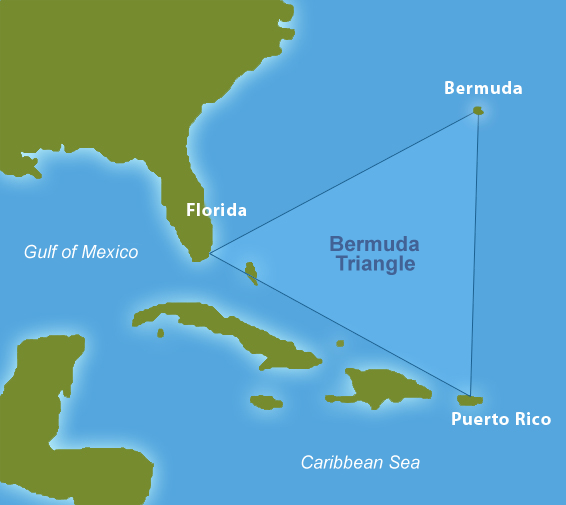
In an article in the Sunday Times, Norman Miller has stated that the conditions responsible for the mystery of the Bermuda Triangle ( which lies between the West Indies islands and the south-eastern coast of USA could provide the answer to the world’s energy crisis. [ad#text-728x15-google]

The energy source is methane gas and there are no alien spaceships or suburbs of Atlantis here. The myth of the Bermuda Triangle, the mysterious disappearances and strange events, has generated much interest all over the world through the years. Charles Berlitz’s book on the subject, published in 1974, sold nearly 20 million copies in 30 languages. Ships, boats, and even aeroplanes are all said to have disappeared in this area and all the mystery has been attributed to extraterrestrials. But scientists now have an explanation for these phenomena and the cause is not extraterrestrial but chemical. It goes by the name of methane gas hydrate, which is methane (created by decomposing organic debris) that has been entombed in an ice crystalline. Conditions are ideal for the formation of this gas in areas of permafrost. Another area is the deep sea floor where the pressure and the temperature are right for the creation of this gas.

It was only in 1981 that a geochemist, Richard McIver, went public on a link between methane gas blowouts and the Bermuda Triangle myth. He stated that massive landslides often occur along the North American continental shelf, which lies to the north of the Bermuda Triangle. Such land slumps can occur over a large area bringing down huge boulders which rupture the layer of gas hydrate beneath the sea floor, freeing the gas that is trapped beneath the hydrate ‘cap’ and also liberating huge amounts of methane trapped within the hydrate itself. The moment a methane gas pocket ruptures a vast reservoir of gas suddenly surges from the seabed, rising up in a huge plume before erupting on the surface within seconds and without warning. A ship caught in such a blowout would be doomed; the water beneath it would suddenly become much less dense, sinking it in a matter of moments. The vessel would plunge into the depths, where it would be covered as sediment disturbed by the blow out settles back on the sea floor. In fact, planes too could fall prey to such a deadly fallout.

The US geological Survey has estimated that just two small areas off the coasts of North and South Carolina, which are a part of the Bermuda Triangle, contain about 70 times the quantity of gas consumed annually in USA. The sea bed and the areas of permafrost are therefore storehouses of a great energy source. It has been estimated that just 1% of gas hydrate is equivalent to half the present conventional gas reserves. But the bad news is that methane is a greenhouse gas and it is vulnerable to blowouts when drillings go wrong. It is only stable under narrow temperature and pressure conditions and would decay due to global warming. We will have to wait and see whether it gives us energy to burn or it burns us up instead!

The Bermuda Triangle (a.k.a. the Devil's Triangle) is a triangular area inPhoto credit: NASA the Atlantic Ocean bounded roughly at its points by Miami, Bermuda, and Puerto Rico. Legend has it that many people, ships and planes have mysteriously vanished in this area. How many have mysteriously disappeared depends on who is doing the locating and the counting. The size of the triangle varies from 500,000 square miles to three times that size, depending on the imagination of the author. (Some include the Azores, the Gulf of Mexico, and the West Indies in the "triangle.") Some trace the mystery back to the time of Columbus. Even so, estimates range from about 200 to no more than 1,000 incidents in the past 500 years. Howard Rosenberg claims that in 1973 the U.S. Coast Guard answered more than 8,000 distress calls in the area and that more than 50 ships and 20 planes have gone down in the Bermuda Triangle within the last century.

Many theories have been given to explain the extraordinary mystery of these missing ships and planes. Evil extraterrestrials, residue crystals from Atlantis, evil humans with anti-gravity devices or other weird technologies, and vile vortices from the fourth dimension are favorites among fantasy writers. Strange magnetic fields andoceanic flatulence (methane gas from the bottom of the ocean) are favorites among the technically-minded. Weather (thunderstorms, hurricanes, tsunamis, earthquakes, high waves, currents, etc.) bad luck, pirates, explosive cargoes, incompetent navigators, and other natural and human causes are favorites among skeptical investigators.

There are some skeptics who argue that the facts do not support the legend, that there is no mystery to be solved, and nothing that needs explaining. The number of wrecks in this area is not extraordinary, given its size, location and the amount of traffic it receives. Many of the ships and planes that have been identified as having disappeared mysteriously in the Bermuda Triangle were not in the Bermuda Triangle at all. Investigations to date have not produced scientific evidence of any unusual phenomena involved in the disappearances. Thus, any explanation, including so-called scientific ones in terms of methane gas being released from the ocean floor, magnetic disturbances, etc., are not needed. The real mystery is how the Bermuda Triangle became a mystery at all.

The modern legend of the Bermuda Triangle began soon after five Navy planes [Flight 19] vanished on a training mission during a severe storm in 1945. The most logical theory as to why they vanished is that lead pilot Lt. Charles Taylor’s compass failed. The trainees' planes were not equipped with working navigational instruments. The group was disoriented and simply, though tragically, ran out of fuel. No mysterious forces were likely to have been involved other than the mysterious force of gravity on planes with no fuel. It is true that one of the rescue planes blew up shortly after take-off, but this was likely due to a faulty gas tank rather than to any mysterious forces.

Over the years there have been dozens of articles, books, and television programs promoting the mystery of the Bermuda Triangle. In his study of this material, Larry Kusche found that few did any investigation into the mystery. Rather, they passed on the speculations of their predecessors as if they were passing on the mantle of truth. Of the many uncritical accounts of the mystery of the Bermuda Triangle, perhaps no one has done more to create this myth than Charles Berlitz, who had a bestseller on the subject in 1974. After examining the 400+ page official report of the Navy Board of Investigation of the disappearance of the Navy planes in 1945, Kusche found that the Board wasn't baffled at all by the incident and did not mention alleged radio transmissions cited by Berlitz in his book. According to Kusche, what isn't misinterpreted by Berlitz is fabricated. Kusche writes: "If Berlitz were to report that a boat were red, the chance of it being some other color is almost a certainty." (Berlitz, by the way, did not invent the name; that was done by Vincent Gaddis in "The Deadly Bermuda Triangle," which appeared in the February, 1964, issue of Argosy, a magazine devoted to fiction.)

In short, the mystery of the Bermuda Triangle became a mystery by a kind of communal reinforcement among uncritical authors and a willing mass media to uncritically pass on the speculation that something mysterious is going on in the Atlantic.

 
Zeitgeist | TNB